Many villa owners in Bali only realize the importance of SOPs (Standard Operating Procedures) after a problem occurs: a guest complains about a leaking bathroom, the swimming pool becomes cloudy during high season, or it turns out that the business permits are incomplete. All of these issues can actually be prevented from the beginning if clear SOPs are in place and consistently implemented.
The Loka has more than 10 years of experience managing hotels and villas in Bali, from Gula Busa in Ketewel and Starloka Saba to Candra Loka in Denpasar and Prama Beach in Canggu. Based on that experience, there are several SOPs that we believe every villa should have, whether it is managed directly by the owner or by a professional villa management service in Bali. Here is our summary.
1. Legal Compliance SOP: The Foundation That Is Often Overlooked
Before talking about neatly folded towels or a clean swimming pool, the most basic thing that must be in order is legal compliance. Without the proper permits, a villa may not legally be rented out commercially, no matter how strong its Instagram marketing is.
Some of the key documents that may be required include a Business Identification Number (NIB), Villa Permit, Building Approval (PBG), and Certificate of Proper Function (SLF). One point that often causes confusion for foreign property owners is that an individual foreign national cannot hold a Pondok Wisata permit, as this permit is specifically available to Indonesian citizens. The route commonly used by foreign investors is to establish a foreign-owned company (PT PMA) and then apply for a Villa Permit under KBLI code 55193.
For properties in areas such as Seminyak, Canggu, or Uluwatu, the permit process is generally handled through the relevant local government licensing authority, such as DPMPTSP in Badung Regency.
The sequence also matters and cannot simply be rearranged: PBG must be issued before applying for SLF, and SLF is a prerequisite before a Villa or Pondok Wisata permit can be issued. If one step is missed, the entire licensing process can come to a standstill.
2. CHSE Certification SOP
CHSE stands for Cleanliness, Health, Safety, and Environmental Sustainability. It is a standard developed by Indonesia's Ministry of Tourism and Creative Economy to ensure that tourism businesses implement clear protocols for cleanliness, health, safety, and environmental sustainability. Villas are among the types of tourism businesses that can and are encouraged to participate in this certification.
The process begins with a self-assessment by the business owner through the official CHSE website, followed by a self-declaration and an audit conducted by a certification body. If the villa passes the assessment, it receives the "I Do Care" label, which can be displayed to potential guests as evidence that its operational standards have been assessed, rather than simply claimed on a website.
It is important to emphasize that CHSE is not simply about placing hand sanitizer at the entrance. The process also requires operators to regularly monitor and evaluate the implementation of cleanliness SOPs, including the use of environmentally friendly products and proper waste management.
3. Housekeeping SOP
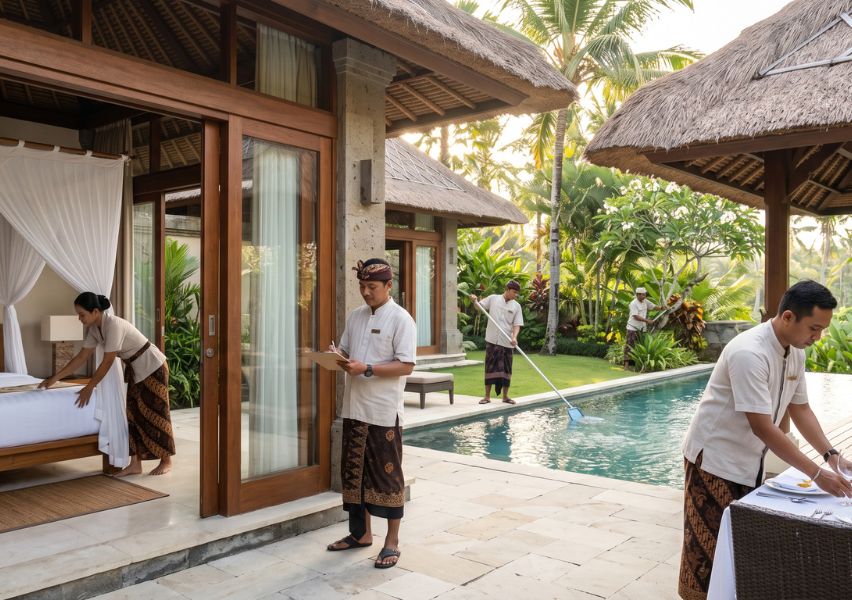
This is the area that guests see most directly, so it is understandable that the standards need to be particularly strict. A villa housekeeping SOP should ideally cover:
Daily cleaning schedules for bedrooms, bathrooms, kitchens, and outdoor areas
Clear schedules for changing linens and towels
Checking and replenishing guest amenities
Inspecting furniture, air conditioning units, and equipment before guest check-in
Reporting any damage to the maintenance team
For villas with private swimming pools, housekeeping should also be responsible for regularly checking the pool area rather than simply waiting for guests to report problems. The more detailed the SOP, the less likely it is that cleaning quality will vary depending on which staff member is on duty.
4. Villa Security SOP
Villa guests, especially families, generally place a high level of importance on the security of the property during their stay. A proper security SOP should include:
Controlled access procedures, including keys, gates, and access codes
CCTV positioned at strategic points without blind spots, particularly in outdoor areas such as entrances, gardens, and parking areas
Adequate outdoor lighting at night
Emergency contact information that guests can easily access 24/7
Key and safe handover procedures for guests' valuables
This SOP is not only about protecting guests but also about protecting the property and the staff working there. Villas with clear security procedures are generally easier to trust, both by OTA platforms and guests making direct bookings.
5. Swimming Pool Maintenance SOP
A swimming pool is often one of the main attractions of a villa, but it can also become a major source of complaints if it is not properly maintained. An ideal SOP should cover regular checks of pH and chlorine levels (ideally maintaining a pH level of around 7.2–7.6 and chlorine at 1–3 ppm), filter backwashing, cleaning the pool walls and floor, and checking the condition of the pump.
In addition to water quality, safety should also be included in the SOP. Cracked or sharp pool edges, loose pool ladders, or damaged flotation devices can all pose a risk of injury to guests. These items should therefore be included in routine inspection checklists rather than waiting for someone to report a problem.
6. Check-in and Check-out SOP
The first and last moments of interaction between guests and the villa are during check-in and check-out, so these processes also require their own SOPs. Key areas to regulate include standard check-in and check-out times, procedures for early check-in and late check-out (including when additional fees may apply), guest identity verification for immigration reporting purposes, and a brief explanation of the villa's facilities and emergency contacts.
7. Routine Inspection and Maintenance SOP
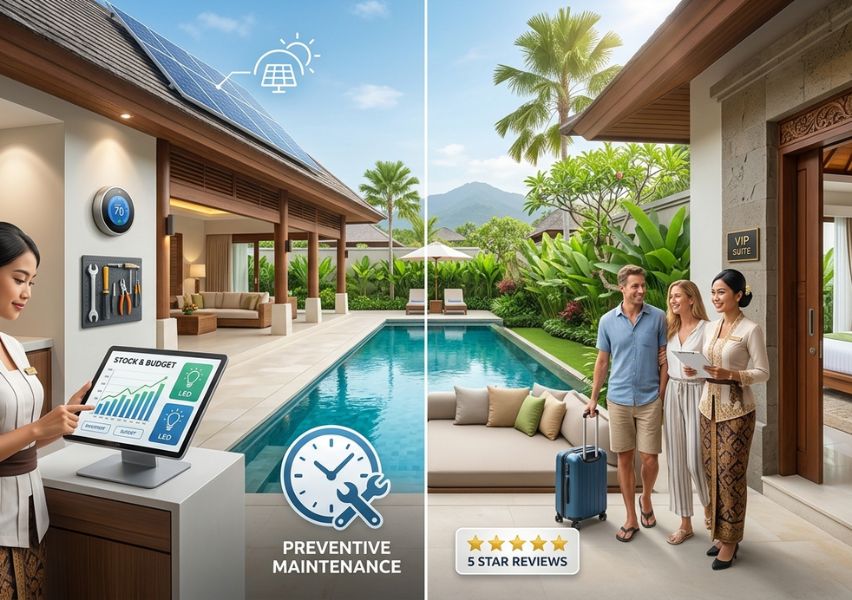
The purpose of this SOP is to prevent minor damage from developing into major and expensive problems. Ideally, inspections should be conducted monthly and cover several areas at once:
Exterior: gardens, walkways, lighting, CCTV, swimming pool, and outdoor furniture
Interior: floors, walls, ceilings, bathrooms, and bedroom equipment
Technical systems: air conditioning, electrical installations, and plumbing
Supporting areas: kitchen, laundry area, and staff rooms
Having a written inspection checklist is far more effective than relying on staff members' memory or intuition, especially when the villa is managed by a team working across different shifts.
8. Emergency and Guest Complaint Handling SOP
A villa also needs SOPs for situations that are beyond normal operations, such as sudden power outages, guests becoming ill, gas leaks, or natural disasters. At a minimum, these SOPs should include a communication flow (who should be contacted first), emergency numbers that must be available in every room, and basic evacuation procedures.
For minor guest complaints, such as an air conditioner that is not cooling properly or slow Wi-Fi, an SOP also helps determine who is responsible for responding and what the target resolution time should be. Guests are generally more understanding of minor problems when the response is quick and clear.
Use a Villa Management Service in Bali
Creating and implementing all of these SOPs independently, especially when the villa owner lives outside Bali or even overseas, is not an easy task. This is where a professional villa management service in Bali becomes relevant: ensuring that all of these SOPs are actually implemented in the field rather than simply existing as documents.
The Loka helps property owners manage their operations comprehensively, from managing housekeeping and security teams and monitoring property conditions to providing transparent reporting through a Property Management System.
FAQ
Do all villas in Bali have to obtain CHSE certification?
CHSE certification is highly recommended and can provide an additional level of trust for guests, although its implementation was initially prioritized for hotels, restaurants, and guesthouses (Pondok Wisata). Villas can and should still participate in the certification to demonstrate that their operational standards have been assessed.
Can a foreigner apply for a Pondok Wisata permit independently for their villa?
No. A Pondok Wisata permit can only be held by an Indonesian citizen. Foreign property owners generally need to establish a PT PMA and apply for a Villa Permit under KBLI code 55193.
How long does it take to obtain complete permits for a commercial villa?
The timeframe varies, but it generally takes around 6–12 months, depending on the completeness of the documents, land zoning, and the processing speed of the relevant local DPMPTSP.